

What Is PAF and Why Does Royal Mail Address Validation Matter for Direct Mail?
What is PAF validation?
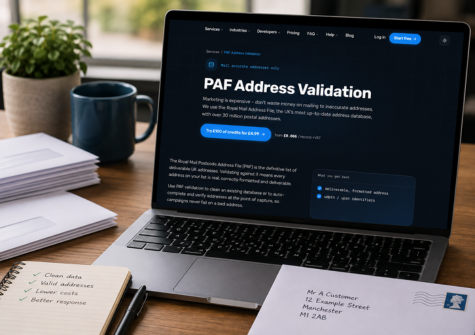
PAF validation checks a UK postal address against Royal Mail's Postcode Address File (PAF), the database of more than 30 million UK addresses that Royal Mail uses for delivery. It confirms whether the address exists, helps correct common errors such as a wrong postcode, and returns it in a standard format so your mail has the best chance of arriving.
If you send direct mail in the UK, the address is the one field you cannot afford to get wrong. PAF validation checks your addresses against Royal Mail's Postcode Address File, flags the ones that do not match and standardises the ones that do, before a campaign goes to print.
For direct mail teams, that means cleaner mailing lists, fewer avoidable addressing problems and greater confidence that the addresses you are using match recognised UK postal addresses.
Here is what PAF is, how validation differs from correction, and a simple checklist for when to run it before your next mailing.
What is PAF (Postcode Address File)?
The Postcode Address File, or PAF, is Royal Mail's database of UK postal addresses. It contains more than 30 million addresses and provides the addressing information Royal Mail uses when delivering mail across the UK.
In simple terms, PAF validation checks whether a UK postal address matches a recognised address in Royal Mail's address data.
PAF includes information such as:
- Postcodes
- Post towns
- Building names
- House numbers
- Street names
- Delivery points
Because addresses can be entered in many different ways, checking against PAF gives businesses a consistent reference point.
For example, a database might contain an incorrect postcode, a misspelt street name or an incomplete combination of address fields. A PAF check can help identify and correct these problems before the data is used.
That is particularly useful for organisations sending large volumes of physical mail.
Royal Mail provides more information about the Postcode Address File.
What does a PAF check actually do?
A PAF check UK service takes an address in your database and compares it with Royal Mail PAF data.
Depending on the data supplied, validation can identify whether the address matches a recognised postal address and return it in a consistent format.
This can help with common database problems such as:
- Incorrect or mismatched postcodes
- Misspelt street names
- Inconsistent address formatting
- Missing or incorrectly entered address elements
- Variations in how the same address has been recorded
The important distinction is that PAF validates an address, not the person living there.
A successful PAF match tells you that the postal address is recognised. It does not, by itself, confirm that a particular customer still lives at that address.
That makes PAF validation one part of good data hygiene rather than a substitute for keeping customer records up to date.
If your database has wider quality problems, read our plain-English guide to data cleaning.
PAF validation vs PAF correction: what is the difference?
Returned mail is often blamed on print or fulfilment. More often, the problem started in the address field.
| PAF validation | PAF correction | |
|---|---|---|
| The question it answers | Does this address match a recognised Royal Mail address? | Which recognised address was this record meant to be? |
| What you get back | A match or no-match result for each record | The corrected address in Royal Mail's standard format |
| Best for | Knowing how much of a list is safe to mail | Rescuing records that would otherwise be returned or dropped |
In practice you want both. Validation tells you how clean your list is. Correction keeps good customers in the campaign instead of losing them to a typo. Anything that still cannot be matched should be checked by hand, not guessed.
Mailing soon? Run your file through Data Soap's PAF checker before it goes to print.
Why does PAF validation matter for direct mail teams?
An inaccurate address can look like a small database problem. Once you multiply it across thousands of records, however, it can affect the cost and effectiveness of an entire campaign.
Reduce wasted direct mail
Printing, envelopes, fulfilment and postage all cost money.
If an address contains errors that could have been identified before mailing, some of that campaign spend may be wasted.
Running direct mail address cleaning before sending gives you an opportunity to identify problematic records before they reach the print or fulfilment stage.
It is a simple principle: clean the list before you pay to mail it.
Improve the quality of your customer data
Address errors rarely stay isolated.
The same database may contain duplicate records, old contact details, invalid phone numbers or email addresses that no longer work.
PAF validation helps address one part of that problem by giving you a consistent way to check UK postal addresses.
For organisations maintaining customer databases over the long term, regular validation can form part of a wider data-cleaning process.
Support better data accuracy
There is also a data-protection reason to care about address quality.
The UK GDPR accuracy principle requires organisations to take reasonable steps to ensure personal data is not incorrect or misleading and, where necessary, is kept up to date.
The ICO specifically uses a change of home address as an example of information that can become inaccurate. If a customer tells an organisation that their address has changed, its records should be updated accordingly.
You can read the ICO's guidance on the accuracy principle.
Again, PAF validation does not tell you whether an individual currently lives at a particular address. However, it can help you check that the postal address itself is valid and correctly structured.
For more on cleaning customer information, see our guide to cleaning and validating a UK customer database for GDPR.
How often should you run a PAF check?
There is no single validation schedule that suits every organisation.
How often you should check your address data depends on how quickly your database changes and what you use it for.
For direct mail teams, a useful rule is to validate the relevant mailing data before a campaign is sent.
This is especially worthwhile when:
- The list has not been used recently
- Data comes from several systems or sources
- Records have been manually entered
- You are preparing a large mailing
- Previous campaigns have highlighted address-quality problems
For an active customer database, you may also decide to schedule periodic checks as part of your wider data-quality process. A quarterly review can be a sensible operational starting point for frequently used databases, although the right frequency depends on your organisation and data.
Validation at the point of entry can prevent some errors from entering the database in the first place. Batch validation then provides an additional check before the data is used for a campaign.
Pre-print checklist: when to run PAF validation
Validate your mailing file before it goes to the printer or mailing house if any of these apply:
- The list has not been mailed or checked for three months or more
- Records came from several sources, such as your CRM, event sign-ups or a rented list
- Addresses were typed in by hand, by customers or by staff
- Your last mailing produced a noticeable number of returns
- You are sending a high-value pack, such as a catalogue or sample, where every wasted item costs more
- Your mailing house or postage scheme asks for address-quality standards
Before you sign off the file, also remove duplicates, suppress anyone who has asked not to receive post from you, screen against the Mailing Preference Service (MPS, the consumer opt-out for addressed marketing mail run by the DMA) and note the date the file was validated. If the same campaign has an email leg, our email list hygiene guide covers the equivalent checks.
PAF check vs address formatting vs postcode lookup: what is the difference?
These terms are sometimes used interchangeably, but they describe different jobs.
Postcode lookup
A postcode lookup typically allows someone to enter a postcode and choose their address from a list.
You will often see this on checkout pages, registration forms and online applications.
Its main purpose is to make entering an address faster and reduce manual input.
PAF validation
Postcode Address File validation checks address data against Royal Mail PAF.
It is particularly useful when you already have a database containing postal addresses and want to validate those records in bulk.
For example, a direct mail team could run its campaign file through PAF validation before sending it to a print house.
Address formatting
Address formatting makes addresses consistent.
It might standardise capitalisation, field order or the way address lines are displayed.
However, formatting something neatly does not necessarily mean the underlying address is valid.
That is the key difference.
Formatting asks: "Is this address presented consistently?"
PAF validation asks: "Does this address match recognised Royal Mail address data?"
For data-cleaning purposes, that second question is much more valuable.
How to run a PAF check with Data Soap
Data Soap lets you run Royal Mail PAF validation alongside your other data-quality checks.
For non-technical teams, you can upload a list through the Data Soap portal and validate records in bulk. This is useful when you have a CSV or Excel file prepared for a direct mail campaign and want to clean it before sending.
For businesses that need address validation built into an existing workflow, Data Soap also provides an API. That means validation can be incorporated into systems such as CRMs, internal applications and campaign workflows rather than relying entirely on manual uploads.
Data Soap's PAF data is updated daily, helping teams work against current address-registry data.
Better still, you do not need a separate platform for every type of contact data.
The same Data Soap account can be used for PAF address validation alongside email validation, mobile and landline checks, TPS and CTPS screening, MPS screening and other data-quality services.
New customers can currently get £100 of Data Soap credits for £4.99 + VAT, including 200 PAF validations as well as credits for the other available validation services.
See Data Soap pricing and start validating your data.
Clean addresses before they reach the post
Every returned item is print and postage you have already paid for. Checking the file against Royal Mail PAF before it goes to print is one of the cheapest ways to protect campaign ROI.
Validate and correct your UK addresses with Data Soap's PAF checker, in bulk through the portal or at the point of capture through the API. See pricing, or start with £100 of credits for £4.99 + VAT as a new customer.
Clean the data first. Then spend money contacting it.
Frequently asked questions
What is PAF in direct mail?
PAF stands for Postcode Address File. It contains Royal Mail's UK postal address data. In direct mail, PAF validation is used to check address records against recognised postal addresses before a mailing campaign is sent.
Is Data Soap PAF licensed?
Data Soap provides Royal Mail PAF address validation, allowing businesses to check UK postal addresses against PAF data. The service is available through both the Data Soap portal and API.
How do I validate UK addresses in bulk?
Upload your address list to a service that provides PAF validation. With Data Soap, you can upload a file through the drag-and-drop portal or use the API for automated workflows. Your records can then be checked in bulk against Royal Mail PAF data.
Does a PAF match mean someone still lives at an address?
No. A PAF match confirms that the postal address is recognised in the address data being checked. It does not confirm that a named person currently lives there. Customer residency and address validation are separate data-quality questions.
Is PAF validation the same as a postcode lookup?
No. A postcode lookup usually helps a user find and select an address when entering data. PAF validation checks existing address data against Royal Mail PAF, making it particularly useful for cleaning databases and direct mail lists.
When should I validate addresses for a direct mail campaign?
Ideally, validate the mailing list before it is passed to print or fulfilment. This gives you an opportunity to identify address problems before you incur printing and postage costs.
Why is my direct mail being returned to sender?
Most returns start with the address data: wrong or outdated postcodes, missing house or flat numbers, misspellings and people who have moved. PAF validation and correction catch the first three before print. They cannot tell you someone has moved, so also record every returned item against the customer and stop mailing that address.
What is the difference between PAF validation and PAF correction?
Validation tells you whether an address matches Royal Mail's PAF. Correction goes further and fixes near-miss records, such as a wrong postcode or misspelt street, returning the correct PAF address in a standard format.
Put clean data to work on your own list.
£100 of credits for £4.99. New customers, once.