

How to check UK phone numbers against TPS and CTPS before a calling campaign
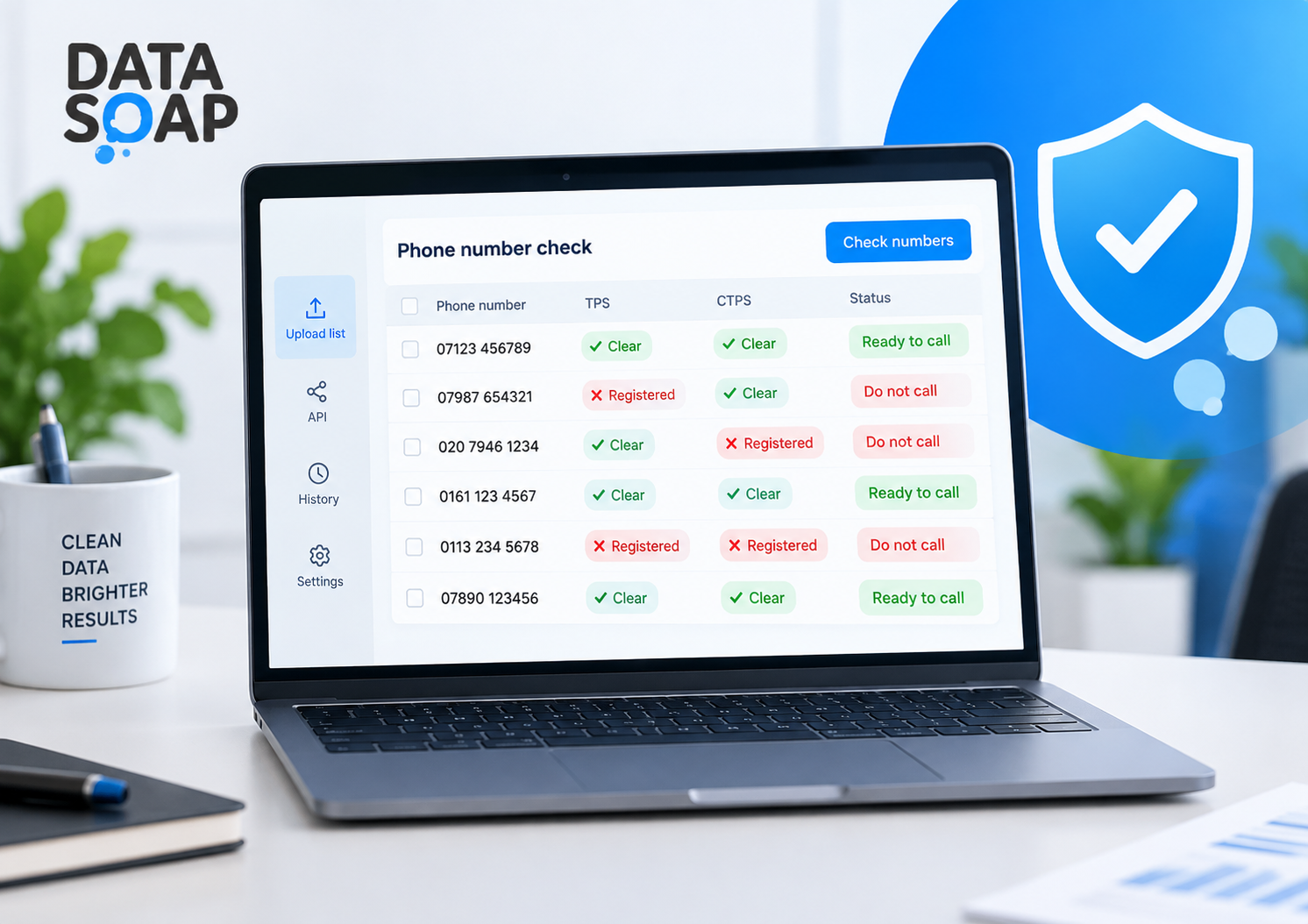
Before starting a UK calling campaign, you should screen your phone numbers against both the Telephone Preference Service (TPS) and Corporate Telephone Preference Service (CTPS), as well as your own do-not-call list. This helps identify numbers that should not receive unsolicited marketing calls before they reach your dialler.
For larger lists, the simplest approach is to use a bulk TPS and CTPS checker. With Data Soap, you can upload a calling list for screening or integrate checks into your workflow using an API, so numbers can be checked before they are used in a campaign.
The important part is not to treat a TPS and CTPS check as a one-off exercise. Registrations and customer preferences can change, so calling data should be screened regularly.
What are TPS and CTPS?
The Telephone Preference Service (TPS) is the UK's official register for people who do not want to receive unsolicited sales and marketing calls.
The Corporate Telephone Preference Service (CTPS) performs a similar role for corporate subscribers. It covers organisations such as limited companies and other corporate bodies that register their telephone numbers to opt out of unsolicited marketing calls.
For telemarketing teams, the distinction matters because a B2B database is not automatically outside TPS rules. Sole traders and some partnerships may register numbers with the TPS, while companies and other corporate subscribers may use the CTPS.
That means a B2B calling campaign may need to be screened against both registers, not just CTPS.
In short:
-
TPS primarily covers individual subscribers, including sole traders and some partnerships.
-
CTPS covers corporate subscribers.
-
B2B calling lists may contain numbers covered by either register.
-
Checking CTPS alone is therefore not enough for many B2B campaigns.
-
Your own suppression or do-not-call list should also form part of the screening process.
For a more detailed explanation, read our guide to checking UK phone numbers against TPS and CTPS.
Why must you check TPS and CTPS before a calling campaign?
The Privacy and Electronic Communications Regulations (PECR) set rules around live direct marketing calls in the UK.
For most live marketing calls, you must not call someone who has previously told your organisation that they do not want your marketing calls. You must also check whether the number appears on the TPS or CTPS register.
A TPS or CTPS registration generally means you cannot make an unsolicited marketing call to that number unless the subscriber has specifically agreed to receive marketing calls from your organisation.
For B2B campaigns, the ICO specifically advises businesses to screen against both TPS and CTPS, because different types of businesses can appear on different registers.
Compliance is not the only reason to screen a list.
Calling numbers that should have been suppressed can also mean:
-
wasted dialler capacity;
-
wasted agent time;
-
avoidable complaints;
-
poorer campaign efficiency; and
-
unnecessary reputational risk.
A TPS and CTPS check should therefore sit near the start of your campaign preparation rather than being something considered after calls have begun.
What happens if you call a TPS or CTPS registered number?
Calling a number that appears on TPS or CTPS without an appropriate basis for doing so can put your campaign in breach of PECR.
Registration with TPS or CTPS acts as a general objection to unsolicited live direct marketing calls. There is an exception where the subscriber has specifically told your organisation that they want to receive your marketing calls.
An existing customer relationship on its own should not be treated as permission to ignore a TPS or CTPS registration.
The ICO can investigate breaches of the UK's electronic marketing rules and take enforcement action. Rather than relying on a headline fine figure, campaign managers should check the ICO's current guidance when planning a campaign because enforcement powers and circumstances can vary.
There are also additional rules for certain types of marketing calls, including claims management services and pension schemes.
The practical rule for an outbound team is straightforward:
Do not put a number into a live marketing campaign simply because it exists in your CRM. Check its current marketing status first.
Your process should include:
-
TPS screening;
-
CTPS screening where relevant;
-
your organisation's own do-not-call or suppression list;
-
any applicable consent records; and
-
the additional rules applying to your particular campaign.
How do you check UK phone numbers against TPS and CTPS?
For an occasional campaign, you can screen a list in bulk. For teams running frequent or continuous outbound campaigns, automated screening through an API can make more sense.
1. Prepare your calling data
Start with the numbers you intend to use in the campaign.
This is also a good opportunity to remove obvious duplicates, incomplete records and data you no longer need.
For a wider database-cleaning process, see our guide to cleaning and validating a UK customer database for GDPR accuracy.
2. Upload the list for screening
With Data Soap, you can upload your data through the portal and run the appropriate checks against your phone records.
Rather than manually checking numbers individually, bulk screening makes it practical to process a complete campaign list before it reaches agents.
3. Check against TPS and CTPS
Screen the appropriate numbers against the relevant preference registers.
For B2B campaigns, don't assume that CTPS is the only register that matters. Because sole traders and some partnerships can be registered with TPS, both registers may need to form part of your screening process.
4. Apply your own suppression data
TPS and CTPS are not substitutes for your internal do-not-call list.
If someone has previously told your organisation that they do not want marketing calls, you need to respect that preference regardless of whether their number appears on TPS or CTPS.
5. Remove or suppress numbers that should not be called
Your cleaned output can then be used to determine which records should be suppressed before the campaign is loaded into your calling workflow.
Keep appropriate records of your screening process so you can understand when and how your data was checked.
6. Automate the process where appropriate
If your organisation is continually adding leads or running outbound activity throughout the week, repeatedly uploading spreadsheets may not be the most efficient workflow.
An API integration allows checks to become part of your data process. For example, a number could be screened as part of the workflow between entering your CRM and becoming available to your outbound team.
The goal is simple: check before dialling, rather than discovering a problem after the call has been made.
TPS vs CTPS: what's the difference and do you need both?
For many calling campaigns, yes.
The difference is based on the type of subscriber rather than whether your campaign happens to be labelled "B2C" or "B2B".
| Register | Primarily applies to | Why it matters |
|---|---|---|
| TPS | Individual subscribers, including sole traders and some partnerships | Relevant to consumer campaigns and some B2B records |
| CTPS | Corporate subscribers | Particularly relevant to B2B marketing |
| Internal suppression list | Anyone who has objected directly to your organisation | Must be respected alongside TPS and CTPS |
This is where B2B teams can make a mistake.
A database containing business contacts is not necessarily a database containing only CTPS-eligible numbers. If it includes sole traders or certain partnerships, some of those numbers may instead appear on TPS.
The ICO's guidance is therefore clear that organisations making B2B live marketing calls need to screen against both TPS and CTPS, alongside their own do-not-call records.
For most outbound teams, the safer workflow is not "TPS or CTPS?" but "which suppression checks apply to this record?"
How often should you re-check TPS and CTPS?
TPS and CTPS screening should be an ongoing part of campaign hygiene rather than a one-time database project.
A list that was screened for an earlier campaign should not automatically be assumed to have the same status months later. People and businesses can change their preferences, new records enter your CRM, telephone numbers change hands and your own suppression list grows.
A sensible workflow is therefore to screen data as close as practical to the point at which it will be used for calling, rather than relying indefinitely on an old result.
For organisations running regular outbound campaigns, this may mean building checks into the normal campaign preparation process or automating them through an API.
Think of it in the same way as other data-quality checks: a clean database does not stay clean forever.
Regular checking helps you:
-
catch newer TPS and CTPS registrations;
-
incorporate internal opt-outs;
-
prevent old campaign data being reused blindly;
-
improve the quality of records reaching agents; and
-
maintain a repeatable compliance process.
Is TPS checking the same as phone number validation?
No. They answer different questions.
A TPS and CTPS check helps determine whether a number is registered on a preference service relevant to unsolicited live marketing calls.
Phone validation is concerned with the quality or status of the number itself.
For example, an outbound team may want to know both:
-
Is this telephone number suitable to include in our calling data?
-
Are we permitted to make this particular type of marketing call to it?
A number can be technically valid and still be registered with TPS or CTPS.
For that reason, good campaign preparation combines data-quality checks with appropriate compliance and suppression checks rather than treating them as the same thing.
What else should you check before launching a calling campaign?
TPS and CTPS screening is one part of preparing a UK outbound campaign.
Before sending a list to your dialler, consider checking:
-
TPS status;
-
CTPS status;
-
internal do-not-call records;
-
consent or other relevant marketing preferences;
-
duplicate records;
-
phone number validity and formatting;
-
whether the data is sufficiently current; and
-
whether additional PECR rules apply to the type of calls you intend to make.
If you use automated dialling technology, you should also understand the rules around abandoned and silent calls and Ofcom's approach to persistent misuse.
The result should be a campaign list that is not simply large, but usable.
Frequently asked questions
Is CTPS the same as TPS?
No. TPS and CTPS are separate preference registers.
TPS covers individual subscribers, including sole traders and some partnerships, while CTPS applies to corporate subscribers. Because a B2B database can contain different types of subscriber, B2B marketers may need to check both registers.
How do I check if a phone number is TPS registered?
You can screen phone numbers against the TPS using an appropriate checking service. If you have a campaign list containing many records, a bulk TPS checker allows you to screen the list before it is loaded into your dialler.
Data Soap can screen phone data against TPS and CTPS alongside other data-validation checks.
Do I need to check CTPS for B2B calls?
Yes, where applicable, but you should not rely on CTPS alone.
The ICO states that some businesses, including sole traders and some partnerships, can register with TPS, while corporate subscribers can register with CTPS. B2B callers therefore need to consider both registers.
Can I call an existing customer if they are registered with TPS?
Do not assume that being an existing customer overrides their TPS registration.
The ICO says you generally cannot make live marketing calls to TPS or CTPS registered numbers unless the subscriber has specifically told your organisation that they agree to receive those calls.
What is the fine for calling a TPS number?
There isn't a single automatic fine that applies every time a TPS-registered number is called.
Breaches of electronic marketing rules can result in ICO investigation and enforcement action, with the outcome depending on the circumstances. For current enforcement information and legal guidance, refer directly to the ICO rather than relying on an old headline fine figure.
Is checking TPS once enough?
No. Treat TPS and CTPS screening as ongoing campaign hygiene.
Calling lists change, subscribers can change their preferences and new data is continually added to CRMs. Re-screen data before future campaigns rather than assuming an old check remains suitable indefinitely.
What is the best way to check a large calling list against TPS and CTPS?
For large lists, bulk screening is generally more practical than checking records individually. Upload the campaign data to a screening service, check the relevant numbers against TPS and CTPS, apply your internal suppression records, and use the resulting data to remove or suppress numbers that should not be called.
For continuous lead generation or high-volume outbound operations, an API can automate the screening process.
Check your calling data before your next campaign
A successful calling campaign starts before the first number is dialled.
Data Soap lets UK marketing and sales teams check data against TPS and CTPS alongside other validation services, with bulk processing for campaign lists and API options for automated workflows.
You don't need a large contract to get started.
Try Data Soap from £4.99.
Put clean data to work on your own list.
£100 of credits for £4.99. New customers, once.